2025 AI & Machine Learning
WWDC25 · 24 min · AI & Machine Learning
What’s new in BNNS Graph
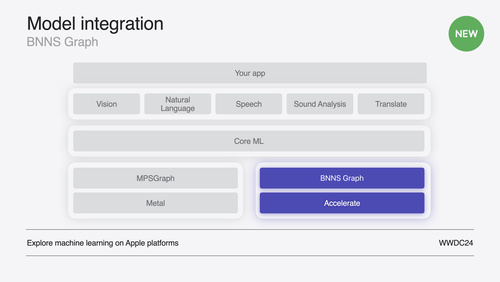
The BNNS Graph Builder API now enables developers to write graphs of operations using the familiar Swift language to generate pre- and post-processing routines and small machine-learning models. BNNS compiles graphs ahead of execution and supports real-time and latency-sensitive use cases such as audio processing. In this session, we revisit last year’s bit-crusher example and simplify the Swift component by removing the reliance on a separate Python file and instead implement the audio effect entirely in Swift. The BNNS Graph Builder API is also suited to pre-processing image data before passing that data to a machine learning model. The session also includes a demonstration of clipping the transparent pixels from an image with an alpha channel.
Watch at developer.apple.com ↗Chapters
Code shown on screen · 8 snippets
Introduction to BNNSGraphBuilder
import Accelerate


func demo() throws {

    let context = try BNNSGraph.makeContext {
        builder in

        let x = builder.argument(name: "x",
                                 dataType: Float.self,
                                 shape: [8])
        let y = builder.argument(name: "y",
                                 dataType: Float.self,
                                 shape: [8])

        let product = x * y
        let mean = product.mean(axes: [0], keepDimensions: true)

        // Prints "shape: [1] | stride: [1]".
        print("mean", mean)

        return [ product, mean]
    }

    var args = context.argumentNames().map {
        name in
        return context.tensor(argument: name,
                              fillKnownDynamicShapes: false)!
    }

    // Output arguments
    args[0].allocate(as: Float.self, count: 8)
    args[1].allocate(as: Float.self, count: 1)

    // Input arguments
    args[2].allocate(
        initializingFrom: [1, 2, 3, 4, 5, 6, 7, 8] as [Float])
    args[3].allocate(
        initializingFrom: [8, 7, 6, 5, 4, 3, 2, 1] as [Float])

        try context.executeFunction(arguments: &args)

    // [8.0, 14.0, 18.0, 20.0, 20.0, 18.0, 14.0, 8.0]
    print(args[0].makeArray(of: Float.self))

    // [15.0]
    print(args[1].makeArray(of: Float.self))

    args.forEach {
        $0.deallocate()
    }
}
Strong typing
// Performs `result = mask0 .< mask1 ? bases.pow(exponents) : 0

let context = try BNNSGraph.makeContext {
    builder in

    let mask0 = builder.argument(dataType: Float16.self,
                                 shape: [-1])
    let mask1 = builder.argument(dataType: Float16.self,
                                 shape: [-1])

    let bases = builder.argument(dataType: Float16.self,
                                 shape: [-1])
    let exponents = builder.argument(dataType: Int32.self,
                                     shape: [-1])

    // `mask` contains Boolean values.
    let mask = mask0 .< mask1

    // Cast integer exponents to FP16.
    var result = bases.pow(y: exponents.cast(to: Float16.self))
    result = result * mask.cast(to: Float16.self)

    return [result]
}
Slicing
let srcImage = #imageLiteral(resourceName: "squirrel.jpeg").cgImage(
    forProposedRect: nil,
    context: nil,
    hints: nil)!

var cgImageFormat = vImage_CGImageFormat(
    bitsPerComponent: 32,
    bitsPerPixel: 32 * 3,
    colorSpace: CGColorSpaceCreateDeviceRGB(),
    bitmapInfo: CGBitmapInfo(alpha: .none,
                             component: .float,
                             byteOrder: .order32Host))!

let source = try vImage.PixelBuffer(cgImage: srcImage,
                                    cgImageFormat: &cgImageFormat,
                                    pixelFormat: vImage.InterleavedFx3.self)

let cropSize = 640
let horizontalMargin = (source.width - cropSize) / 2
let verticalMargin = (source.height - cropSize) / 2

let destination = vImage.PixelBuffer(size: .init(width: cropSize,
                                                 height: cropSize),
                                     pixelFormat: vImage.InterleavedFx3.self)

let context = try BNNSGraph.makeContext {
    builder in

    let src = builder.argument(name: "source",
                               dataType: Float.self,
                               shape: [ -1, -1, 3])

    let result = src [
        BNNSGraph.Builder.SliceRange(startIndex: verticalMargin,
                                     endIndex: -verticalMargin),
        BNNSGraph.Builder.SliceRange(startIndex: horizontalMargin,
                                     endIndex: -horizontalMargin),
        BNNSGraph.Builder.SliceRange.fillAll
    ]

    return [result]
}

source.withBNNSTensor { src in
    destination.withBNNSTensor { dst in

        var args = [dst, src]

        print(src)
        print(dst)

        try! context.executeFunction(arguments: &args)
    }
}

let result = destination.makeCGImage(cgImageFormat: cgImageFormat)
Preprocessing by thresholding on mean
let srcImage = #imageLiteral(resourceName: "birds.jpeg").cgImage(
    forProposedRect: nil,
    context: nil,
    hints: nil)!

var cgImageFormat = vImage_CGImageFormat(
    bitsPerComponent: 16,
    bitsPerPixel: 16,
    colorSpace: CGColorSpaceCreateDeviceGray(),
    bitmapInfo: CGBitmapInfo(rawValue: CGBitmapInfo.byteOrder16Little.rawValue |
                             CGBitmapInfo.floatComponents.rawValue |
                             CGImageAlphaInfo.none.rawValue))!

let source = try! vImage.PixelBuffer<vImage.Planar16F>(cgImage: srcImage,
                                                       cgImageFormat: &cgImageFormat)
let destination = vImage.PixelBuffer<vImage.Planar16F>(size: source.size)

let context = try BNNSGraph.makeContext {
    builder in

    let src = builder.argument(name: "source",
                               dataType: Float16.self,
                               shape: [-1, -1, 1])

    let mean = src.mean(axes: [0, 1], keepDimensions: false)

    let thresholded = src .> mean

    let result = thresholded.cast(to: Float16.self)

    return [result]
}

source.withBNNSTensor { src in
    destination.withBNNSTensor { dst in

        var args = [dst, src]

        try! context.executeFunction(arguments: &args)
    }
}

let result = destination.makeCGImage(cgImageFormat: cgImageFormat)
Postprocessing
func postProcess(result: BNNSTensor, k: Int) throws -> ([Float32], [Int32]) {

    let context = try BNNSGraph.makeContext {
        builder in

        let x = builder.argument(dataType: Float32.self,
                                 shape: [-1])

        let softmax = x.softmax(axis: 1)

        let topk = softmax.topK(k, axis: 1, findLargest: true)

        return [topk.values, topk.indices]
    }

    let indices = context.allocateTensor(argument: context.argumentNames()[0],
                                         fillKnownDynamicShapes: false)!
    let values = context.allocateTensor(argument: context.argumentNames()[1],
                                        fillKnownDynamicShapes: false)!

    var arguments = [values, indices, result]

    try context.executeFunction(arguments: &arguments)

    return (values.makeArray(of: Float32.self), indices.makeArray(of: Int32.self))
}
Bitcrusher in PyTorch
import coremltools as ct
from coremltools.converters.mil import Builder as mb
from coremltools.converters.mil.mil import (
    get_new_symbol
)

import torch
import torch.nn as nn
import torch.nn.functional as F

class BitcrusherModel(nn.Module):
    def __init__(self):
        super(BitcrusherModel, self).__init__()

    def forward(self, source, resolution, saturationGain, dryWet):
        # saturation
        destination = source * saturationGain
        destination = F.tanh(destination)

        # quantization
        destination = destination * resolution
        destination = torch.round(destination)
        destination = destination / resolution

        # mix
        destination = destination * dryWet
        destination = 1.0 - dryWet
        source = source * dryWet

        destination = destination + source

        return destination
Bitcrusher in Swift
typealias BITCRUSHER_PRECISION = Float16

let context = try! BNNSGraph.makeContext {
    builder in

    var source = builder.argument(name: "source",
                                  dataType: BITCRUSHER_PRECISION.self,
                                  shape: [sampleCount, 1, 1])

    let resolution = builder.argument(name: "resolution",
                                      dataType: BITCRUSHER_PRECISION.self,
                                      shape: [1, 1, 1])

    let saturationGain = builder.argument(name: "saturationGain",
                                          dataType: BITCRUSHER_PRECISION.self,
                                          shape: [1, 1, 1])

    var dryWet = builder.argument(name: "dryWet",
                                  dataType: BITCRUSHER_PRECISION.self,
                                  shape: [1, 1, 1])

    // saturation
    var destination = source * saturationGain
    destination = destination.tanh()

    // quantization

    destination = destination * resolution
    destination = destination.round()
    destination = destination / resolution

    // mix
    destination = destination * dryWet
    dryWet = BITCRUSHER_PRECISION(1) - dryWet
    source = source * dryWet

    destination = destination + source

    return [destination]
}
Changing precision
typealias BITCRUSHER_PRECISION = Float16

let context = try! BNNSGraph.makeContext {
    builder in

    var source = builder.argument(name: "source",
                                  dataType: BITCRUSHER_PRECISION.self,
                                  shape: [sampleCount, 1, 1])

    let resolution = builder.argument(name: "resolution",
                                      dataType: BITCRUSHER_PRECISION.self,
                                      shape: [1, 1, 1])

    let saturationGain = builder.argument(name: "saturationGain",
                                          dataType: BITCRUSHER_PRECISION.self,
                                          shape: [1, 1, 1])

    var dryWet = builder.argument(name: "dryWet",
                                  dataType: BITCRUSHER_PRECISION.self,
                                  shape: [1, 1, 1])

    // saturation
    var destination = source * saturationGain
    destination = destination.tanh()

    // quantization

    destination = destination * resolution
    destination = destination.round()
    destination = destination / resolution

    // mix
    destination = destination * dryWet
    dryWet = BITCRUSHER_PRECISION(1) - dryWet
    source = source * dryWet

    destination = destination + source

    return [destination]
}
Resources
Related sessions
-
 20 min
 -
 19 min